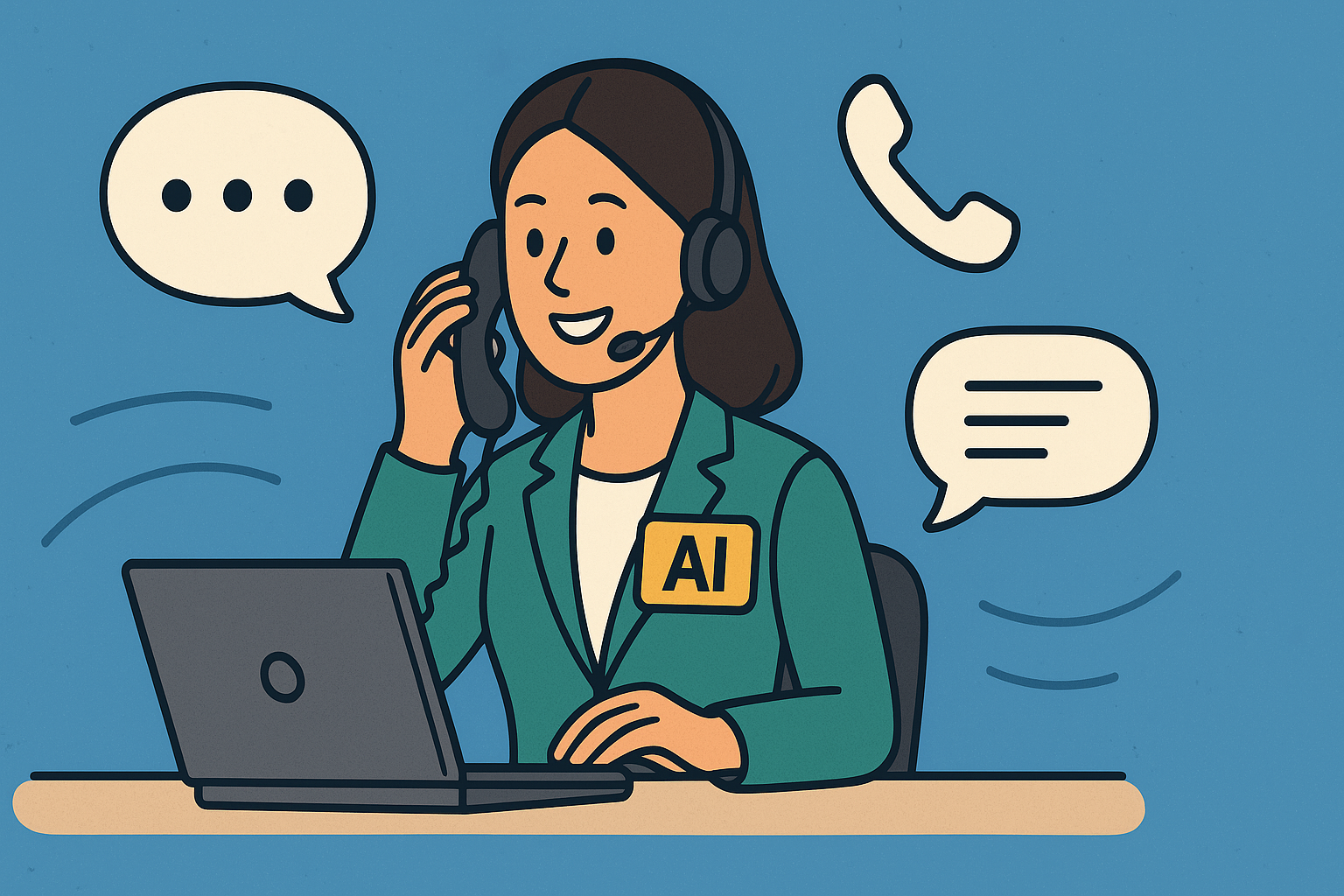
There was a time when the background noise of call centers was made up of headphones, fast keyboards and a few puffs between one assistance call and another. Today that sound is changing. And not because customers have suddenly become more patient, but because at the other end of the line there may no longer be a human: there could be a virtual AI operator capable of speaking, understanding, acting and above all never missing a beat. Not even on Monday morning.
The truth is that Voice AI technologies are entering customer care departments with the same discretion as an elephant in a crystal shop: they make noise and move everything. But, unlike the elephant, they bring order, coherence and an ability to scale volumes that the most expert of human operators, at a certain point, cannot physically manage.
Because call centers are really changing
We are no longer at the IVR that asks you to press button 1 to talk to a human being and button 2 to wait forever. The new generation vocal AI communicates, remembers, reasons, collects information, fills out tickets, updates CRM, sends follow-ups, and does so in real time, with an always fresh voice and a neutral tone even in front of the most... "creative" customers.
Companies are quickly realizing this: if a human operator can handle 1 call at a time, a virtual operator handles hundreds in parallel, with no breaks, holidays, overtime or coffee needed to survive the seasonal peak.
And for CFOs, this isn't technology: it's poetry.
What about human operators? They don't disappear, they evolve (and breathe a sigh of relief)
The irony is that among those who best welcome this revolution are the most experienced operators.
Why?
Because AI takes care of everything that no one really wants to do: repetitive calls, basic requests, bureaucratic operations, reminders, automatic updates, order status checks. That "same conversation 15 times a day" that drains energy and doesn't enhance any skills.
Human personnel do not disappear: they change roles. From traditional call centers we will increasingly move to teams specialized in:
- management of complex cases;
advanced customer experience;
empathic escalations;
supervision of AI flows;
quality control and tuning of conversational models.
In other words: less “answering routine questions”, more “solving real problems”.
Paradoxically, AI does not take away value from operators: it prevents them from wasting it.
The future? Call centers as centers of intelligence, not volume
In a few years, the idea of an operator spending eight hours on the phone repeating the same phrases will seem like a distant, if not exactly archaeological, memory. Call centers will become:
supervising hubs of AI agents handling gigantic volumes;
customer journey labs, with conversational data driving products and services;
hybrid environments where humans and AI collaborate without overlapping.
Those who today begin to adopt AI virtual operator solutions are not "cutting costs": they are building a competitive advantage that will become the new normal in the coming years.
The moral of the story
The future of call centers will not be made up of pavilions full of people talking at the same time. It will be AI handling the bulk of the traffic, while human professionals handle what requires empathy, judgment and experience.
And, if we want to say it with a pinch of irony, in the call centers of the future the only tired voice will be that of the operators... when they tell their new colleagues what "prehistory" was like, before AI started managing difficult calls with the zen calm of those who never lose patience.