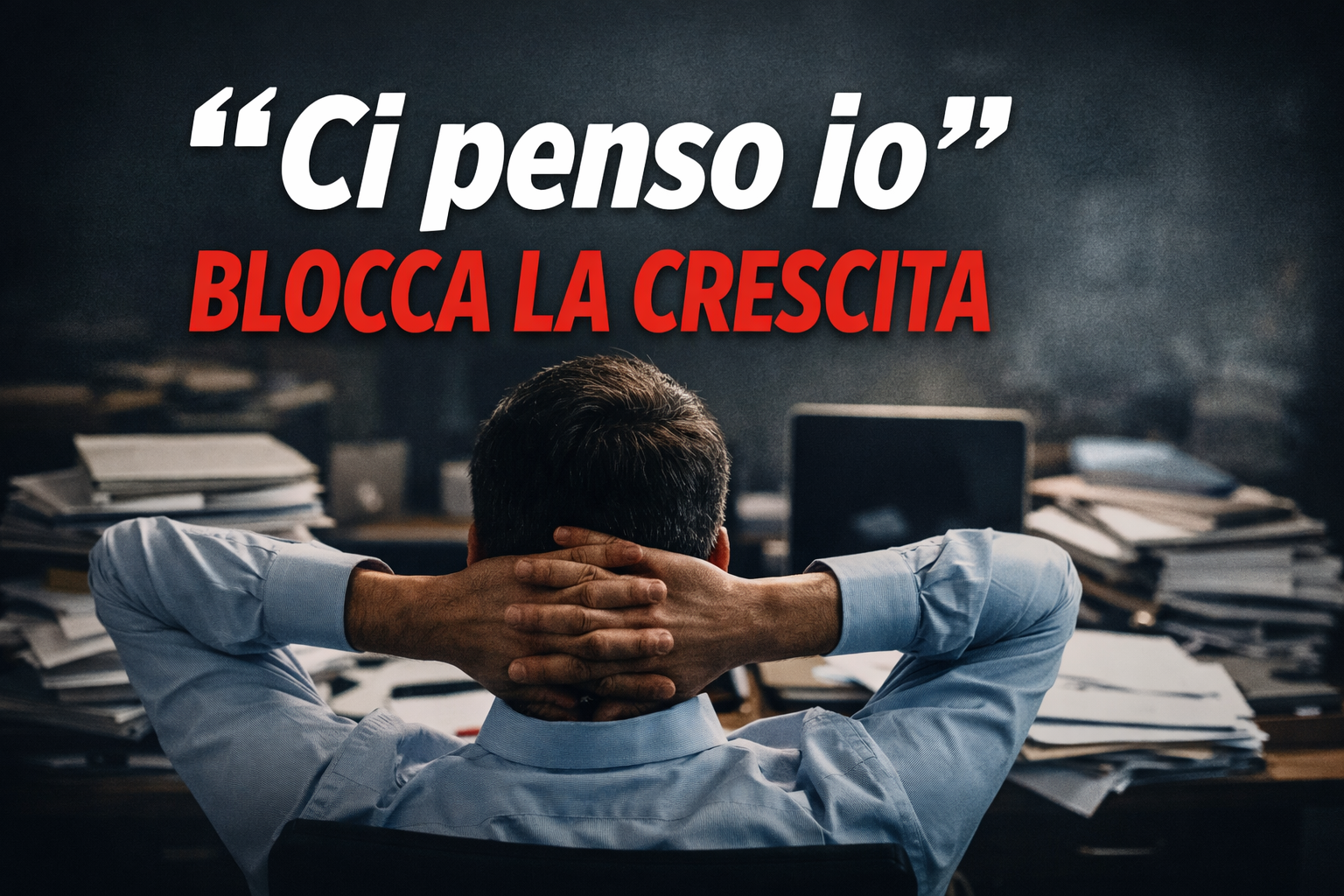
When turnover and opportunities increase, but the lack of structure hinders decisions, delegations and results.
There is a paradox running through many Italian SMEs with the same persistence as an Excel report opened months ago and never updated: solid revenues, clear growth opportunities, markets knocking at the door… and a managerial structure still governed by the “we’ll handle it ourselves” principle. The result is an organisation that keeps moving, but without a map, a compass, and—quite often—without real delegation.
This is not a lack of entrepreneurial talent. On the contrary, Italian SMEs are full of capable, visionary, and tireless entrepreneurs. The issue arises when the company grows faster than its governance model. Decisions remain centralised, responsibilities are informally distributed, and strategy becomes blurred by day-to-day operations. In this context, the idea of hiring an executive or a structured manager is perceived as expensive, risky, or simply premature. Translation: “we’ll do it when we’re bigger”. Spoiler alert: without structure, you often never get bigger.
This is where two still underestimated yet extremely pragmatic roles come into play: the Fractional Manager and the Temporary Manager. These are not slide-driven consultants or rigid, full-time executives locked into an organisational chart. They are real managers, with hands-on experience, who enter the company to solve specific problems, build processes, and transfer know-how. The key difference is simple but crucial: they do not just advise on what to do, they do it alongside the organisation.
The Fractional Manager is the modern answer to “I need a director, but not full time”. They bring senior-level expertise—marketing, finance, operations, HR, digital—working for a fraction of the time, at a sustainable cost and with maximum flexibility. It is the smartest way to introduce strategic thinking without burdening the structure. More importantly, it acts as a cultural accelerator: introducing KPIs, clear accountability, and measurable priorities. In short, it helps move the company out of permanent “fire-fighting mode”.
The Temporary Manager, on the other hand, is the right choice when a company is going through a critical phase: rapid growth, restructuring, generational transition, or market expansion. They operate with a clear mandate, a defined time horizon, and measurable objectives. They do not need time to settle in: they enter, analyse, decide, and execute. And when the job is done, they leave behind stronger processes, teams, and capabilities.
For SMEs, the real benefit is not just financial it is strategic. These roles finally allow a separation between “doing” and “deciding”, freeing the entrepreneur from being the universal bottleneck. They make it possible to test more advanced organisational models without irreversible commitments. And above all, they reduce risk: the risk of growing badly, missing opportunities, or realising too late that the company has become complex without ever becoming structured.
In a market where improvisation is no longer a competitive advantage, engineering SME growth starts here: temporary leadership, clear accountability, and repeatable processes. It is not a revolution. It is simply sound management, applied with intelligence. And, ironically enough, it often costs less than trying to do everything on your own.