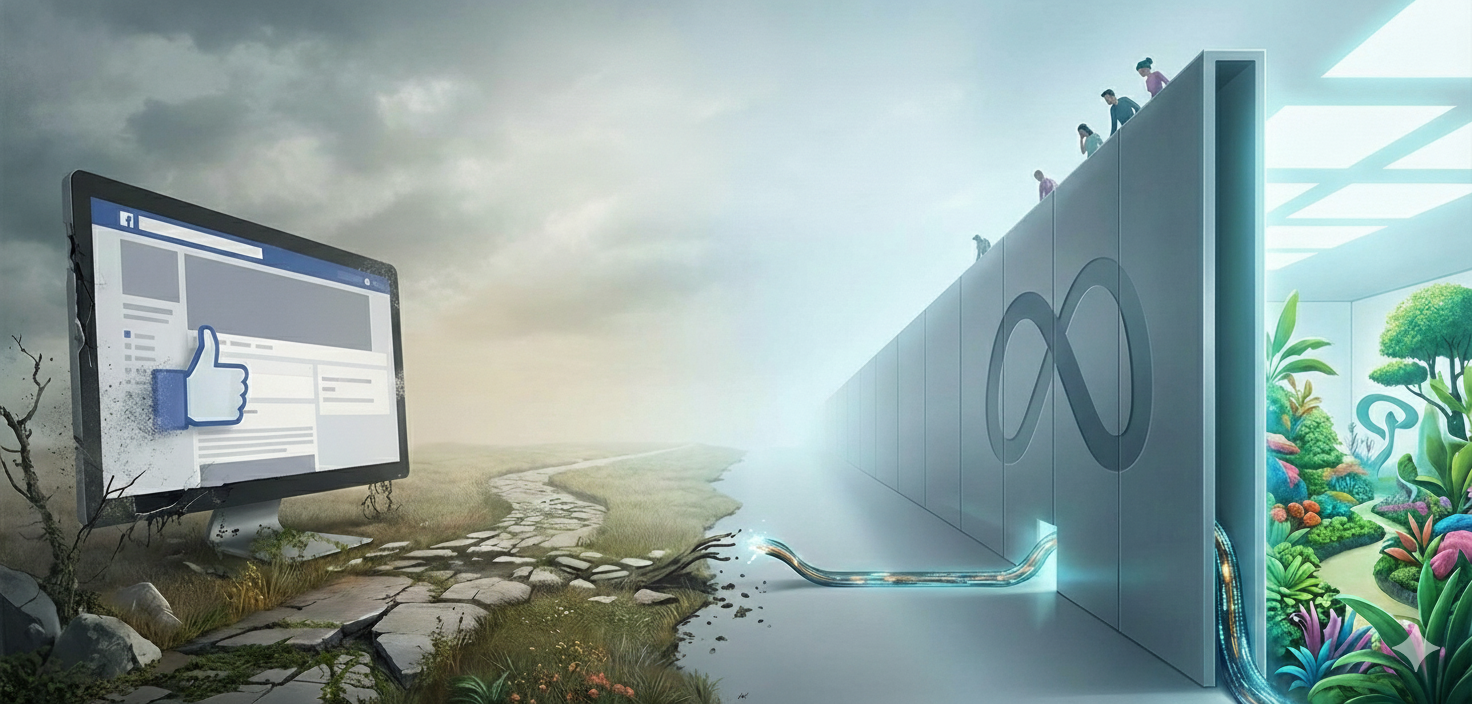
If you thought 2026 would finally deliver flying cars or digital peace, you will be disappointed. Instead, it will be remembered as the year Mark Zuckerberg officially decided to shut the castle gates. Starting on February 10, 2026, the familiar “Like” and “Comment” buttons will disappear from third-party websites, turning social plugins into digital ghosts. This is not a system error, but a deliberate decision communicated with that trademark corporate optimism Meta calls “simplification,” and which the rest of the world would more accurately describe as a forced relocation. The announcement marks the end of the dream of an interconnected web and the definitive rise of walled gardens, where the user is the guest of honor—yet can never step into the garden without the owner’s permission.
For the average user, the impact will be a forced return to a kind of media asceticism. No longer will we be able to endorse an article or politely insult a food critic directly from the page we are reading; to do so, we will have to undertake the titanic effort of copying the link and pasting it into the official app. It is the triumph of induced laziness: Meta is betting that, rather than leaving the platform, users will prefer to consume content exclusively within the feed. From an investor perspective, the outlook grows hazy. The disappearance of plugins removes immediate “social proof.” Without that reassuring Like counter signaling a product’s worth, conversions will require far more sophisticated strategies than simply relying on Facebook’s aura. Advertisers will be forced to shift every cent into the closed ecosystem, where data remains certain and control absolute—formally declaring the death of the organic traffic that once flowed freely between social networks and external sites.
For small publishers, the situation takes on the features of an enforced eviction. That little blue button was not mere vanity, but the equivalent of a “Fully Booked” sign outside a restaurant, reassuring passersby. From February 10 onward, that sign will become an invisible pixel, leaving blogs in an almost claustrophobic silence. Managing the public square will become an unsustainable burden: delegating moderation to Meta was a free convenience, whereas now small players must choose whether to invest in proprietary comment systems or turn their sites into one-way monologues—effectively becoming digital sharecroppers confined to Facebook Groups or WhatsApp Channels.
And viral posts? They will simply change address—and DNA. Virality will no longer serve as a bridge between a publisher’s site and the wider world, but as a purely endogenous phenomenon. Other platforms, after all, have already paved the way: TikTok and X never believed in deep integration, preferring from the outset to keep users glued to their proprietary algorithms. Content marketing strategies must therefore evolve: the newsletter sheds its vintage accessory status and becomes the only lifeboat for capturing first-party data. In this new world order, success will no longer be decreed by a blue thumb, but by the ability to build a direct relationship with the reader—who must return to the site not because of a notification, but because they found something worth reading even without being able to shout it to the world with a single click.