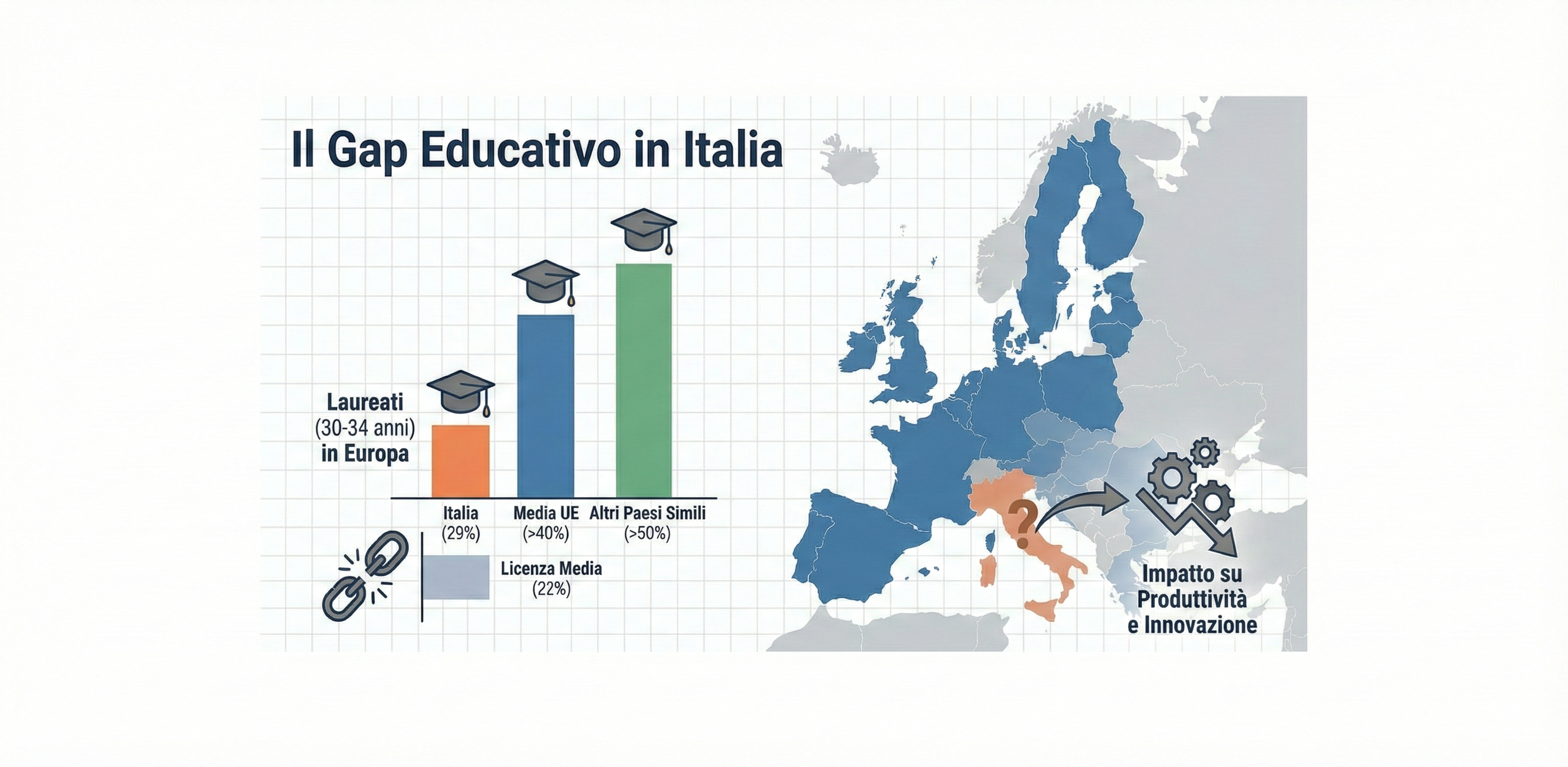
If knowledge is the oil of the twenty-first century, Italy is trying to run a Ferrari on cooking oil. Analyzing Eurostat data, we find ourselves faced with a merciless picture, almost embarrassing for a member of the G7: only 29% of Italians between 30 and 34 have a degree. A fact that relegates us to the bottom of the European rankings, arm in arm with Romania, while we look through binoculars at countries like France, Spain or Ireland, where the 50% bar has been exceeded some time ago.
The detail that makes the painting grotesque, if not tragic, is the male component. Among young Italian men, only 22% have a degree. On the other hand, 26% stopped at middle school. We literally have more thirty-year-olds who can barely analyze a complex text than we have who can plan for the future. It is legitimate to ask whether this is not the epicenter of Italian "decay". The answer, unfortunately, tends towards yes. The low productivity that has afflicted us for thirty years is not a divine curse, but the direct consequence of a productive fabric that does not innovate because it lacks the human capital to do so. We cannot expect to compete on the global technological frontier if the workforce is stuck, culturally, in the 1980s.
This educational gap also perfectly explains the apparent paradox of youth unemployment and low wages. We are trapped in what economists call "low-level equilibrium": few degrees because businesses (often family-run microbusinesses) do not require high skills, and businesses that remain small and uninnovative because they cannot find (or do not want to pay) graduates. It's a dog chasing its tail, while the rest of Europe runs. The lack of propensity to innovate is not laziness, it is technical inability. Without engineers, scientists and humanists capable of critical thinking, innovation remains an empty conference word.
To get out of this cognitive swamp and aim for the fateful 50% of graduates, we need a shock, not a thousand-extension decree. Looking at what nations like South Korea or, closer to us, France have done, the road is clear but steep. The government must stop treating education as an expense item to be cut and start seeing it as the only investment with a guaranteed return.
The first necessary action is a massive and structural refinancing of the Right to Education. In Italy studying is still a luxury: there is a lack of accommodation, scholarships are small and often awarded late. In Germany or Scandinavia, the student is supported by the state because he is considered a public resource; in Italy it is often considered a burden on the family. We need to make university economically accessible to everyone, eliminating taxes for medium-low incomes and building real university residences, not on paper.
Secondly, a drastic intervention is needed on school orientation and on combating dropout. That 22% stuck in eighth grade is a failure of the State. The Nordic countries invest huge resources in early orientation, directing children towards paths that match their aptitudes with the reality of the world. In Italy, orientation is often a brochure read listlessly in a spare hour. We must strengthen the professionalizing supply chain (the ITS), copying the German dual model, to recover those who do not want a classic academic path but still need to acquire high-level technical skills, removing them from the limbo of "neither study nor work".
Finally, we need a shock tax incentive for companies that hire PhDs and master's graduates, to break the vicious circle of low demand for skills. If we cannot convince our young people that studying pays, and if we do not convince our companies that ignorance costs much more, we will continue to look at the Eurostat rankings from the bottom up, consoling ourselves with the usual rhetoric of the "Italian genius", while the world overtakes us to the right